
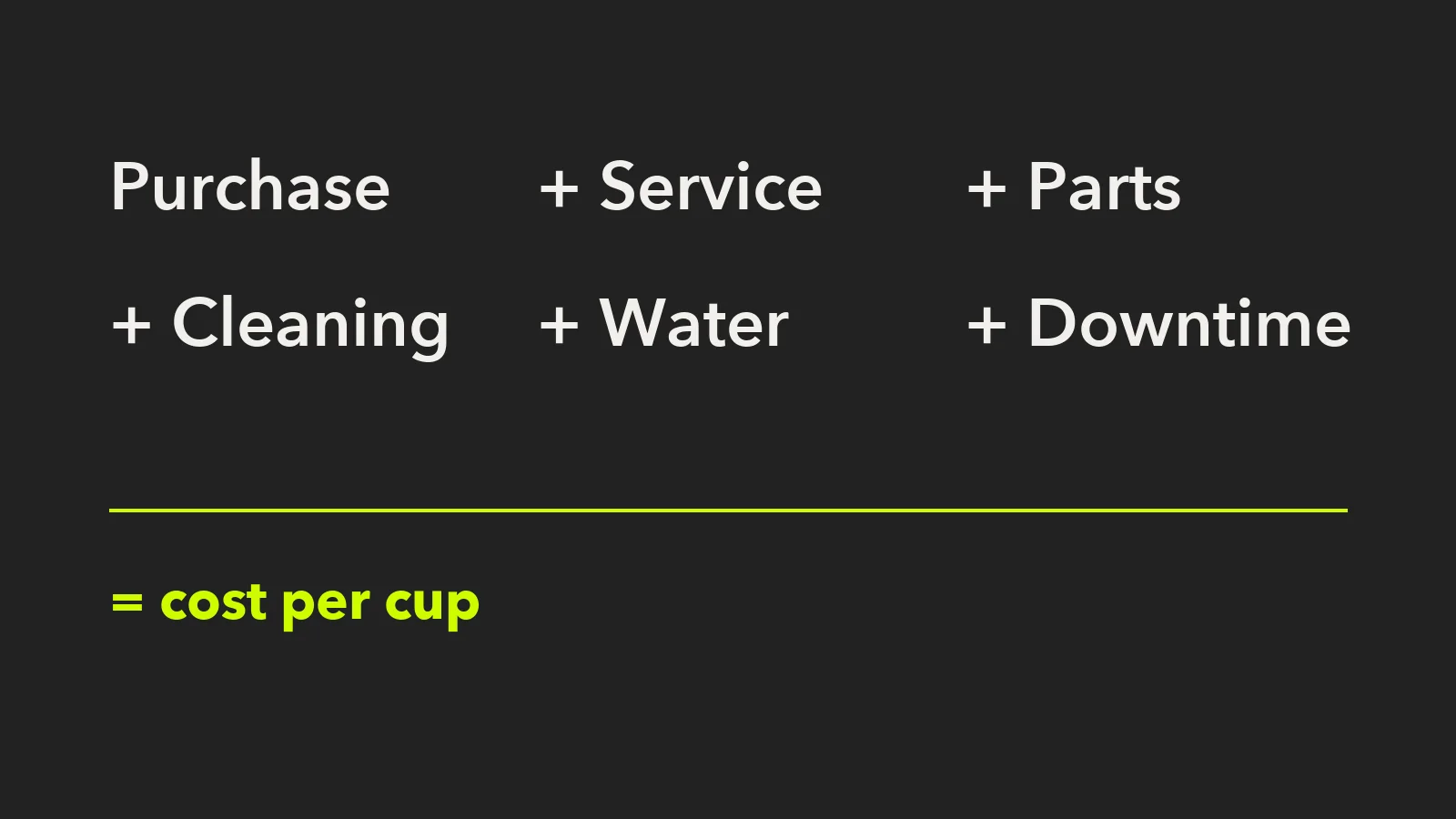
Short answer: the price on the quote is only part of what a fully automatic coffee machine costs you. Over its life you also pay for service visits and the technician's travel, wear parts, cleaning products, water treatment, energy, and every hour the machine is out of service. Compare machines on their cost per cup over the years you plan to keep them, choose one sized for your volume, and ask each supplier for its maintenance plan before you sign.
Two machines with similar prices can cost very different amounts by the time you replace them. The difference rarely shows on the quote. It shows in how often a technician has to come, what they replace, and how many busy mornings the machine is off.
What goes into the total cost
- Purchase, or the lease or finance payments.
- Installation and staff training.
- Scheduled maintenance: the technician's time and their travel, which can be a large share of each visit.
- Wear parts replaced at those visits, such as seals, valves and tubes.
- Unplanned repairs between visits.
- Cleaning products for the daily cycle.
- Water treatment: a filter or softener, and its cartridges.
- Energy.
- Downtime: drinks you could not sell, and customers who went elsewhere while the machine was off.
- End of life: what the machine is worth when you replace it, and when that will be.
Compare on cost per cup
Add up the costs above for the years you expect to keep the machine, then divide by the cups it will serve in that time. The result, a cost per cup, lets you compare machines with different prices, volumes and service needs on equal terms. It also connects the machine to your menu: our guide on how to cost and price a cup of coffee shows where equipment sits in the price of each drink.
Size the machine to your volume
A machine running close to the top of its capacity every day wears faster, needs service more often and has less in reserve for your busiest hour. A machine sized with some headroom usually costs less to run, even if it costs more to buy. Count your cups per day and, just as important, your peak hour: see How many cups a day? Matching the machine to the site.
Preventive maintenance costs less than breakdowns
A preventive maintenance plan replaces wear parts before they fail. A breakdown costs more: an unplanned trip, often an urgent part, and lost sales while you wait. Two things to keep in mind:
- Usage sets the rhythm. Parts wear with the number of drinks, so a busy site needs visits more often than a quiet one with the same machine. A plan stated only in months, with no reference to volume, is incomplete.
- Plan visits around your trade. Schedule them before your busy season, not in the middle of it.
How the machine's design affects what you pay
- Access. The faster a technician reaches the components, the shorter and cheaper each visit.
- Modules. Main assemblies that come out as a unit can be swapped on site and repaired in the workshop.
- Remote diagnosis. A connected machine tells the technician what is wrong before they set off, so the first visit can fix it. Our CARIcare guide explains how this works on Carimali machines.
- Local support. Check that trained technicians and spare parts are available where your sites are.
Daily care is the cheapest maintenance
Much of what a technician fixes starts with daily care. Run the cleaning cycle every day (how to clean the milk system), treat the water to suit your supply (choosing a water treatment system), and train every shift on the routine, not only the manager.
Questions to ask before you buy
- How often does this machine need a service visit at my volume, and what does each visit include?
- Which parts wear out, and roughly what do they cost over a year?
- Who carries out the service where my sites are, and are their technicians trained on this model?
- How long will spare parts remain available for this model?
- Can the machine be monitored and diagnosed remotely?
- What cleaning products and water treatment does it need, and what do they cost?
- What happens if the machine stops at my busiest hour?