
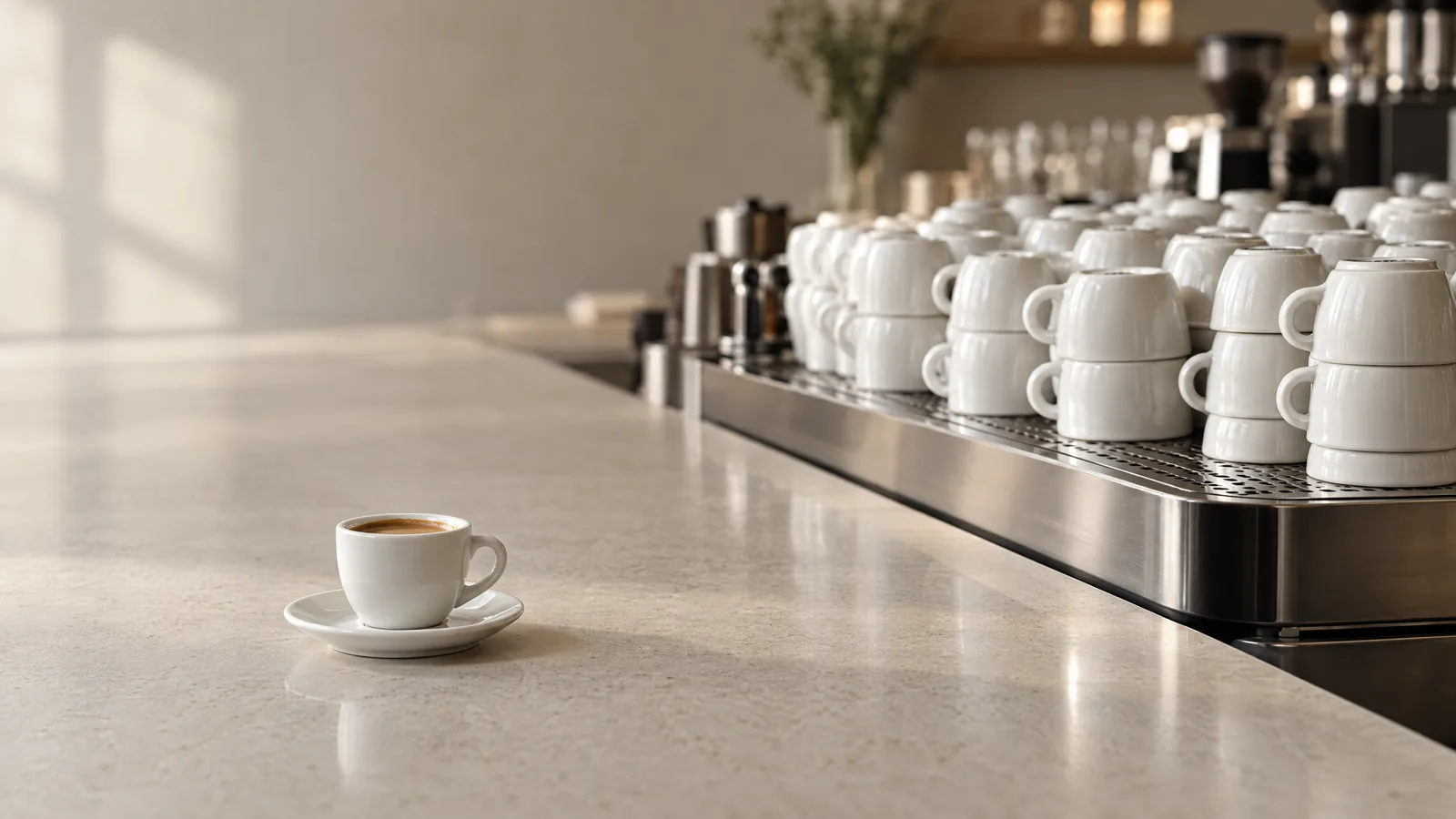
Short answer: count the drinks you make on a normal day and in your busiest hour, then ask who will make them and who will clean the machine. A professional espresso machine pays its way when it works: in a café, a restaurant or a hotel making tens or hundreds of drinks a day. If you make five or six coffees a day, its daily care, energy and servicing fall on very few cups, and a capsule or compact machine will usually serve you better.
A small volunteer team recently asked us which of our machines would suit them. They make five or six coffees a day, on a capsule machine they chose for its simplicity. We looked at the options with them and gave the honest answer: keep the capsule machine. This article explains why, and how the same reasoning works further up the scale.
Why does daily volume change the right machine?
Most of what it costs to run a professional machine has nothing to do with how many cups it makes.
A traditional machine holds a boiler at temperature through the working day. Its group heads need cleaning at the end of every service. Its water filter needs changing on a schedule set by your water and your volume. Its gaskets and seals harden with heat and time, whether the machine made fifty drinks that week or five hundred. A technician's visit takes the same time either way.
A super-automatic machine automates much of the cleaning, but someone still has to run the cycles, empty the grounds container and look after the milk system.
Spread those fixed costs over two hundred drinks a day and they disappear into the price of each cup. Spread them over five and they become the main cost. Our guide to costing and pricing a cup of coffee shows how to put numbers on this for your own site.
What does a professional machine need every day, whatever the volume?
Whatever the daily count, a professional machine asks for the same routine:
- Group or brewing-unit cleaning at the end of each day of service, with the detergent the manufacturer specifies.
- Milk system cleaning every day you use it. Milk residue is a hygiene problem within hours, at any volume.
- Emptying and rinsing the drip tray and, on super-automatics, the grounds container.
- Water treatment sized for your water. Hard water scales a boiler whether you make ten cups or a thousand; our article on choosing a water treatment system covers how to size it.
- Planned maintenance, usually at intervals set by the number of cycles or by time, whichever comes first.
None of this is difficult. It needs someone who knows it is their job. In a café that person is obvious. In an office, a fire station or a workshop, it is often nobody, and a neglected professional machine makes worse coffee than a well-kept capsule machine.
Three kinds of site, three different answers
| Very low volume | Café and restaurant | High-volume hospitality | |
|---|---|---|---|
| Typical sites | A small office, a volunteer station, a workshop, a guest house | Independent cafés, restaurants, bakeries, bars | Hotel breakfast service, busy bars, canteens, chains |
| Drinks a day | Single figures | Tens to a couple of hundred | Hundreds, concentrated in peaks |
| Who makes the coffee | Whoever is there | Trained staff, often one or two baristas | Staff who change shift to shift, or customers themselves |
| What usually fits | Capsule or compact machine | Traditional machine, or a super-automatic if staff change often | Super-automatic machines, often more than one |
| The care question | Will anyone clean it? | Is cleaning part of the closing routine? | Can cleaning cycles fit around service? |
The boundaries between columns are not sharp. A café with a high staff turnover may be better served by a super-automatic than by a traditional machine it cannot staff. A small hotel may sit between the second and third columns. The table is a starting point for the conversation, not a verdict.
When is a capsule or compact machine the honest answer?
When the volume is in single figures and nobody owns the machine's care. A capsule machine gives a consistent cup to anyone who presses the button. It needs no grinder setting, no daily backflush and no technician on call. It wastes little coffee at low volume, and it costs little to replace.
The trade-off is cost per cup and packaging waste, which grow with volume. At five coffees a day, that trade-off favours the capsule. As daily volume climbs into the tens, the balance shifts towards a professional machine, provided someone looks after it. At café and hotel volumes, a capsule machine stops being a realistic option.
A professional machine bought for a site that makes five coffees a day tends to end up underused, cleaned irregularly and serviced late. That is a poor result for the site and for the machine, and we would rather say so before the purchase than after.
How do you size a machine at the high end?
At high volume, the daily total matters less than the busiest hour.
A hotel breakfast service can put most of the day's coffee into two hours. A bar near a station can do much of its day's trade before mid-morning. A machine that comfortably handles the daily average can still leave a queue at the peak. Size for the peak:
- Count the drinks in your busiest hour, or better, your busiest fifteen minutes, from your till data.
- Weight for milk drinks. A cappuccino takes longer than an espresso, and a menu heavy in milk drinks needs more capacity for the same number of cups.
- Check the rest of the line. The grinder, the milk, cups and the till can each cap throughput below what the machine could manage.
- Consider two machines rather than one larger one. Two machines keep service running if one needs attention, and let you match capacity to quiet and busy periods.
Manufacturers publish daily capacity figures for super-automatic machines. The Carimali Armonia U, for example, is specified at around 250 cups a day. Use figures like this to compare machines against each other, then check them against your own peak count rather than your daily average.
How does service cost change as volume rises?
At low volume, a machine ages more from time than from use. Scale builds up, seals harden and water sits in the circuit. Each service visit costs the same as it would in a busy café, but the site has far fewer cups to spread it over.
At high volume, wear follows the number of cycles. Brew groups, grinder burrs, valves and pumps reach their service intervals faster, and planned maintenance becomes part of running the site rather than a response to faults. The cost of a service visit is spread over thousands of drinks, and the cost that matters is downtime: a machine out of action at breakfast loses sales by the minute.
In both cases, the distance to your nearest service partner matters. Ask who will come, and from where, before you choose the machine.
Eight questions to answer before you choose
- How many drinks do you make on a normal day?
- How many in your busiest hour?
- What share are milk drinks, and do you need plant-based or cold milk?
- Who makes the coffee, and are they trained?
- Who cleans the machine, and when?
- How hard is your water?
- Who services the machine, and how far away are they?
- Do you have the space, power, water supply and drain the machine needs?
If the answer to question 1 is a single figure and the answer to question 5 is "nobody in particular", you have your answer already.
Frequently asked questions
Can I use a professional machine for ten coffees a day? You can, if someone takes care of it every day. Expect a higher cost per cup than a café would see, because the energy, cleaning and servicing do not shrink with volume.
Is a super-automatic easier to look after than a traditional machine? Easier to use, because it grinds, doses, brews and froths at the touch of a button. It still needs its cleaning cycles run, its grounds emptied and its milk system cleaned every day it is used.
What does a "cups per day" rating mean? It is the daily output the manufacturer designs the machine for in normal use. It describes capacity across a day, not how the machine copes with your busiest fifteen minutes.
Should a high-volume site buy one large machine or two smaller ones? Often two. Two machines keep service running if one is down for cleaning or repair, and let you match capacity to the busy and quiet parts of the day.
What is the right machine for a small office? For a handful of coffees a day with nobody in charge of the machine, a capsule or compact machine. Once an office makes enough drinks to justify a super-automatic, make one person responsible for its daily care.
This article is part of the Vea Group knowledge base. Vea Group S.p.A. is an Italian designer and manufacturer of professional and premium coffee machines, with heritage dating to 1919 and production in Chignolo d'Isola, Italy, and Suzhou, China.