
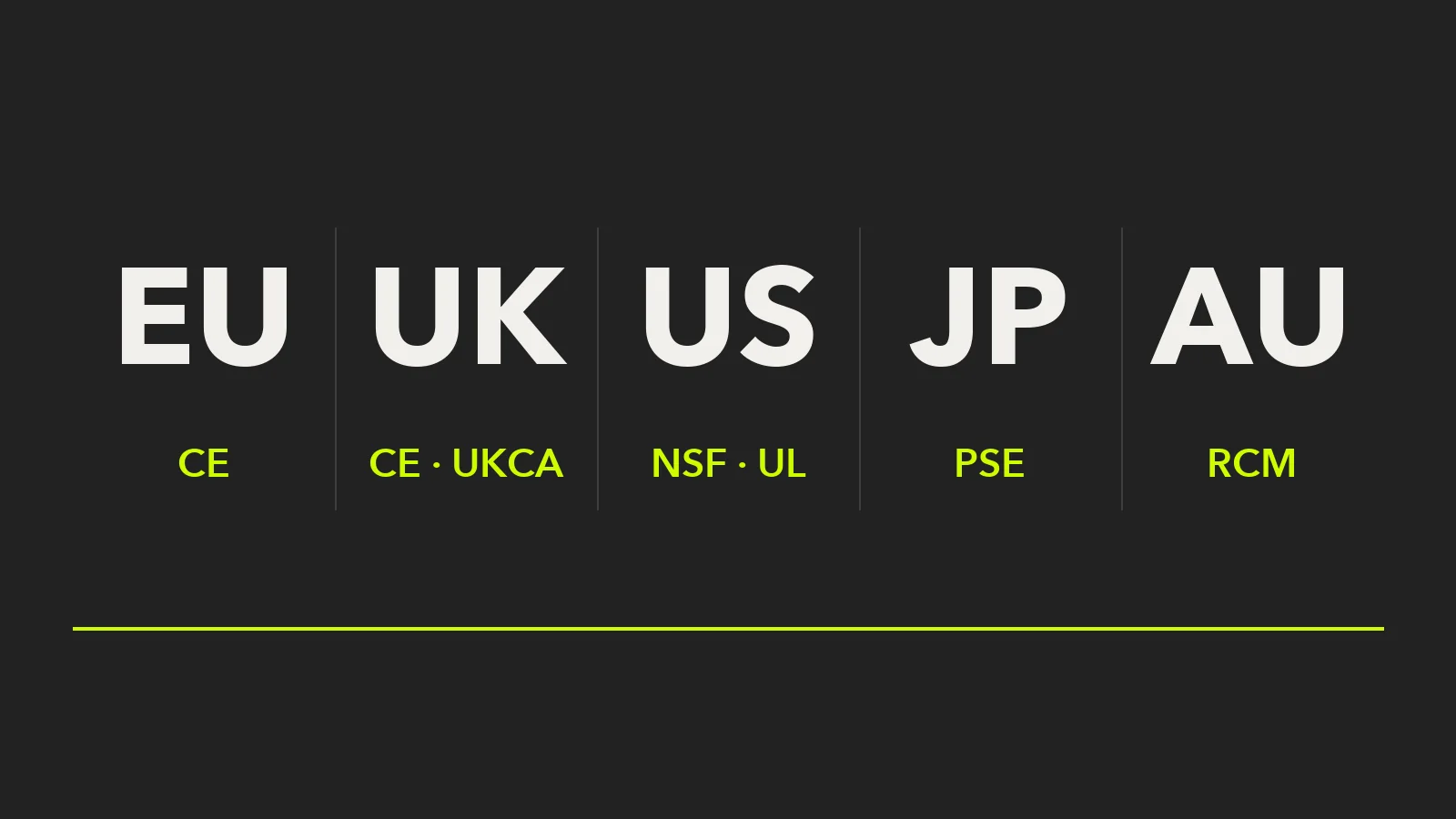
Short answer: no single certificate opens every market. A commercial espresso or bean-to-cup machine sold in the EU carries the CE marking, which the manufacturer declares itself. Great Britain still accepts CE for these products, but a machine plumbed into the mains must also meet the water-fittings rules. The US needs an electrical listing from a recognised laboratory and, for food service, NSF sanitation certification. Japan needs PSE conformity, notified by the importer or manufacturer. Australia needs the RCM, a registered local responsible supplier and WaterMark-certified water connections. A Wi-Fi module adds radio approvals in every one of these markets.
This guide covers commercial machines: mains-powered, often plumbed into the water supply, with a pressurised boiler, parts in contact with food and, more and more often, a Wi-Fi module. It reflects the rules as of November 2026. Regulations change, so check the current text before you ship.
The five markets at a glance
| Market | Electrical safety | Who declares or certifies | Water connection | Radio (Wi-Fi) |
|---|---|---|---|---|
| EU | CE: Machinery Directive (Regulation 2023/1230 from 20 January 2027), EN 60335-2-75 | The manufacturer, by self-declaration; a notified body only in specific cases | Food-contact rules (Regulation 1935/2004) | Radio Equipment Directive, including cybersecurity |
| Great Britain | CE recognised indefinitely, or UKCA | The manufacturer or importer | Water Supply (Water Fittings) Regulations 1999 | Covered by CE recognition |
| Northern Ireland | CE (or CE plus UKNI) | As in the EU | Its own water regulations | As in the EU |
| United States | Listing by an OSHA-recognised laboratory (UL 197) | UL, Intertek (ETL) or another NRTL | NSF/ANSI 4 sanitation, low-lead parts | FCC Part 15 |
| Japan | PSE under the Electrical Appliance and Material Safety Act | The Japanese importer or manufacturer, by notification to METI | Food Sanitation Act positive list for plastics | Technical conformity (Giteki) mark |
| Australia | RCM under the EESS, AS/NZS 60335.2.75 | A registered Australian responsible supplier | WaterMark for hoses and backflow devices; AS/NZS 4020 materials | RCM (ACMA rules) |
European Union: CE marking
Which rules apply. A commercial coffee machine with a motor-driven pump, grinder or brewing unit counts as machinery. The Machinery Directive excludes only household appliances for domestic use, and the European Commission's guide to the Directive states that appliances for commercial use are not excluded. These machines still have to meet the electrical safety objectives of the Low Voltage Directive, but under the Machinery Directive. From 20 January 2027 the new Machinery Regulation (EU) 2023/1230 replaces the Directive; machines placed on the market before that date under the old Directive can continue to be sold.
The other pieces:
- EMC Directive 2014/30/EU for electromagnetic compatibility, if the machine has no radio module.
- Radio Equipment Directive 2014/53/EU if a Wi-Fi or Bluetooth module is built in. A permanently fitted module makes the whole machine radio equipment, and the RED then covers its electrical safety and EMC as well. Since 1 August 2025 the RED also sets cybersecurity requirements for internet-connected equipment.
- RoHS 2011/65/EU on hazardous substances in electrical equipment.
- Pressure Equipment Directive 2014/68/EU for boilers above 0.5 bar. Each boiler's category depends on its own pressure and volume. A boiler in category II or above needs a notified body, even inside a machine; below that, the manufacturer's own assessment applies.
- Food contact: Regulation (EC) 1935/2004 requires every part in contact with food or drinks to be inert, and Regulation 2023/2006 sets good manufacturing practice. Plastic parts also follow Regulation 10/2011, with a written declaration of compliance passed along the supply chain.
The standard. EN 60335-1 together with EN 60335-2-75 covers commercial dispensing appliances, including coffee makers with or without an integrated grinder.
Who signs. The manufacturer runs the conformity assessment, compiles the technical file and signs the EU Declaration of Conformity. For a coffee machine no third party is needed, except for a pressure vessel in category II or above, or for RED cybersecurity where the harmonised standards are not fully applied.
CE without a CB report. An IECEE CB test report is not a legal requirement for CE. It is useful for something else: one test report that national certification bodies in other countries accept for their own schemes, which saves repeating the tests market by market.
Energy labels. The EU ecodesign rules for coffee machines, Regulation 2023/826, apply to household machines only. Commercial machines have no EU energy label.
Coming next. The Cyber Resilience Act applies in full from 11 December 2027 to products with digital elements, which includes connected coffee machines.
United Kingdom
Great Britain. Since 1 October 2024 the UK government recognises the CE marking indefinitely in Great Britain for electrical safety, EMC, machinery, pressure equipment, radio equipment and RoHS. UKCA remains available as an alternative, but a CE-marked machine can be sold in England, Scotland and Wales. For the new EU Machinery Regulation, the UK government has said it intends to keep recognising CE.
Northern Ireland follows EU rules: products must carry the CE marking, alone or with UKNI, and cannot carry UKCA alone.
Water. In England and Wales, any appliance connected to the mains water supply must comply with the Water Supply (Water Fittings) Regulations 1999: its materials and design must be of an appropriate quality and standard. WRAS approval is the best-known way to show this. WRAS itself states that the approval is not mandatory, but the testing of the product is, and it names coffee machines among the products that must comply. Other approval schemes exist, and Scotland and Northern Ireland have their own regulations.
United States
A commercial machine needs an electrical safety listing from a laboratory that OSHA recognises (UL 197 is the usual standard), sanitation certification to NSF/ANSI 4 for food service, and FCC authorisation for any radio. We explain each step in Selling an espresso machine in the US: NSF, UL and ETL certification explained.
Japan
PSE. The Electrical Appliance and Material Safety Act covers appliances that match an item on its official list, whether they are sold for home or business use. Electric coffee makers sit among the non-specified items, which carry the round PSE mark. Specified items, the higher-risk part of the list, carry the diamond mark and need third-party inspection.
Who is responsible. The Japanese importer or manufacturer, not the foreign factory, notifies the Ministry of Economy, Trade and Industry within 30 days of starting the business, for each type of product. It then inspects the products and keeps the records. Since 25 December 2025 a foreign seller can also notify as a "specified importer", through an administrator in Japan.
Model or factory? The notification names the type and the manufacturer. If the same model is made by a second factory or a different legal entity, the importer updates the notification. The design work does not start again, but the paperwork does.
Food contact. Japan's Food Sanitation Act applies a positive list to synthetic resins in contact with food, with full compliance required since 1 June 2025. Machine parts that touch food count as apparatus. Metal and rubber parts are outside the positive list.
Wi-Fi. Radio equipment needs the technical conformity mark (Giteki) from a registered body. A pre-certified module is the usual route; modifying the module voids its certification.
Australia
Electrical safety. Australia's Electrical Equipment Safety System (EESS) covers equipment from 50 to 1,000 V designed or marketed for household, personal or similar use, even if it is also marketed for commercial use. Whether a café machine counts as "similar use" is not settled across regulators, so treat it as in scope. In-scope equipment carries the RCM, and its responsible supplier, which must be an Australian legal entity, registers on the national EESS database before selling. A commercial coffee machine is not on the list of higher-risk items, so if it is in scope it falls in the lowest risk level: the supplier keeps evidence of compliance (typically AS/NZS 60335.1 and AS/NZS 60335.2.75) for five years. The RCM also covers the ACMA rules on EMC and radio; a CE marking alone is not enough.
Water. The WaterMark scheme lists the plumbing products that need certification. For a coffee machine that means the inlet hose and the backflow prevention device at least. Commercial espresso and bean-to-cup machines are not named on the schedule, so a WaterMark certifier decides through a risk assessment whether the machine itself needs certification. Every material in contact with drinking water must meet AS/NZS 4020, and the lead-free rules tighten: only lead-free products can be newly certified from 1 May 2026, and installed from 1 May 2028.
What to ask your manufacturer before you import
- The EU Declaration of Conformity for the exact model and voltage, listing every directive or regulation it covers.
- The test reports behind it, and a CB test report if you will certify in other countries.
- Food-contact declarations for plastic parts, and the material specifications for metal parts in the water path.
- For connected machines, the radio test reports and the cybersecurity assessment under the Radio Equipment Directive.
- For each target market, which version of the machine is certified: voltage, frequency, plug, water connection and radio module often differ.
- Who acts as the responsible party in the market: importer, distributor or the manufacturer's local entity.
Frequently asked questions
Does CE marking require a CB report? No. The manufacturer declares CE conformity on the basis of its own technical file. A CB report helps when you certify the same machine in other countries.
Do I need UKCA to sell a coffee machine in Great Britain? No, for the product areas listed above. Great Britain recognises CE indefinitely. Northern Ireland requires CE.
Is a commercial coffee machine exempt from PSE in Japan because it is for business use? No. Business use does not exempt a product that matches a listed item.
Does a plumbed coffee machine need WaterMark in Australia? Its hose and backflow device do. For the machine itself, ask a WaterMark certifier: commercial coffee machines are not named on the schedule, so a risk assessment decides.
Does a Wi-Fi module change anything? Yes, in every market: radio rules in the EU, FCC authorisation in the US, Giteki in Japan, ACMA compliance under the RCM in Australia, and cybersecurity requirements in the EU.
For our approach to building and certifying machines for other brands, read Is OEM right for your coffee-machine brand?.