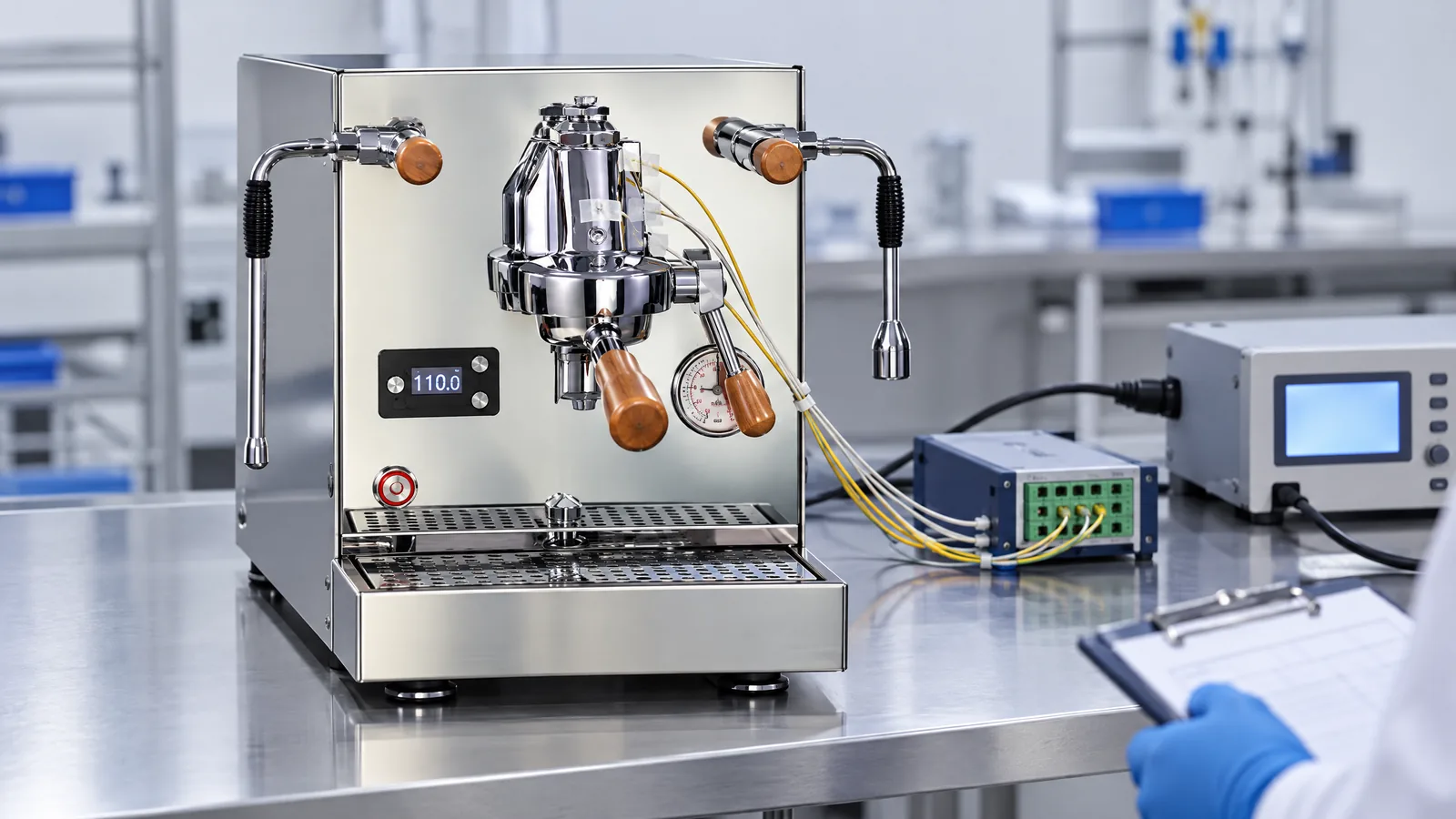
Short answer: a commercial espresso machine sold in the United States needs two separate certifications. The first is electrical safety: a Nationally Recognized Testing Laboratory such as UL or Intertek (ETL) lists the machine to UL 197, the standard for commercial electric cooking appliances. The second is sanitation, usually to NSF/ANSI 4, which is what health inspectors look for in a food-service business. Add FCC authorisation if the machine has Wi-Fi or Bluetooth. A CE-marked European machine meets none of these on its own.
We get asked about the US market by distributors looking for a model they have seen in Europe and by brands planning their own machines. The questions repeat, so here are the answers in one place.
Who asks for these marks, and why?
Customs does not ask for a UL or NSF mark when a coffee machine is imported. The checks come later, from people who can each stop a machine from going into service.
- Electrical inspectors and building officials, known in the US as the authority having jurisdiction, approve the equipment installed in a commercial building. They generally accept equipment listed by a recognised testing laboratory, and they can refuse equipment that is not.
- Health inspectors check food equipment in restaurants, cafés and hotels. The FDA Food Code, which most state and local health codes adopt, treats equipment certified for sanitation by an ANSI-accredited programme as compliant. In practice the inspector looks for an NSF mark or an equivalent sanitation mark.
- OSHA, the federal workplace-safety agency, expects electrical equipment used by employees to be approved, which in practice means listed by a recognised laboratory.
- Insurers, landlords and franchisors often write listed equipment into their conditions.
- Chains, dealers and distributors write the marks into their specifications, because they carry the risk if a machine fails an inspection at a customer's site.
A machine without the marks is not illegal to own. It is hard to install, hard to insure and hard to sell to anyone who has to pass an inspection.
UL or ETL: which one does a machine need?
Either. This is the point that confuses buyers most.
UL Solutions and Intertek, which issues the ETL mark, are both Nationally Recognized Testing Laboratories under OSHA's programme. Both test commercial espresso machines to the same standard, UL 197. OSHA does not prefer one laboratory over another, and inspectors accept both marks as proof of compliance. CSA Group is also recognised and issues its own mark.
The choice between laboratories is commercial: capacity, cost, location and existing relationships. It says nothing about which machine is safer.
For Canada, the matching standard is CSA C22.2 No. 109 for commercial cooking appliances. Laboratories can test to the US and Canadian standards together and issue one mark with "C" and "US" indicators, so a single listing can cover both markets.
What does NSF/ANSI 4 cover?
NSF/ANSI 4 sets sanitation requirements for commercial cooking and hot-holding equipment, and it is the standard commercial espresso machines are usually certified to. The evaluation looks at:
- Materials. Every surface in contact with water, coffee or milk has to be made of a material accepted for food contact. NSF/ANSI 51 covers food equipment materials.
- Cleanability. Surfaces in the food zone have to be smooth, accessible and free of crevices or joints that trap residue.
- Design details: drainage, how parts come apart for cleaning, and how the machine sits on the counter.
- Lead content. Since the 2023 revision of NSF/ANSI 51, parts in contact with water, coffee or tea must be evaluated for lead, against the 0.25% weighted-average limit that US law sets for drinking-water plumbing, using the method in NSF/ANSI/CAN 372. Brass fittings that are standard in many European machines may need replacing with low-lead alloys.
Intertek, also accredited for sanitation, tests to the same NSF/ANSI standards and issues its ETL Sanitation mark. Health inspectors look for a recognised sanitation mark, not a particular laboratory's name.
What changes in the machine itself?
Engineers, not stickers, make a US version. The typical changes:
- Electrical supply. The US runs at 60 Hz, with 120 V for smaller loads and 208 to 240 V for larger ones. A European machine is designed for 230 V at 50 Hz. Heating elements, pumps and motors all change, and a motor designed for 50 Hz runs faster at 60 Hz.
- Components. Switches, relays, wiring, cord and plug have to be recognised for the North American market, and the wiring follows American gauge and colour conventions.
- Materials. Food-zone parts and water-path fittings change to meet the sanitation and lead rules.
- Markings and manuals. Rating plates, warnings and documentation follow US formats and language.
- Accessories. A milk fridge is a refrigeration appliance and is certified under refrigeration standards, separately from the coffee machine.
That is why manufacturers sell North American versions as separate models. In our own range, the North American versions of some traditional machines carry their own product codes, voltage and component list, distinct from their European equivalents.
What about connected machines?
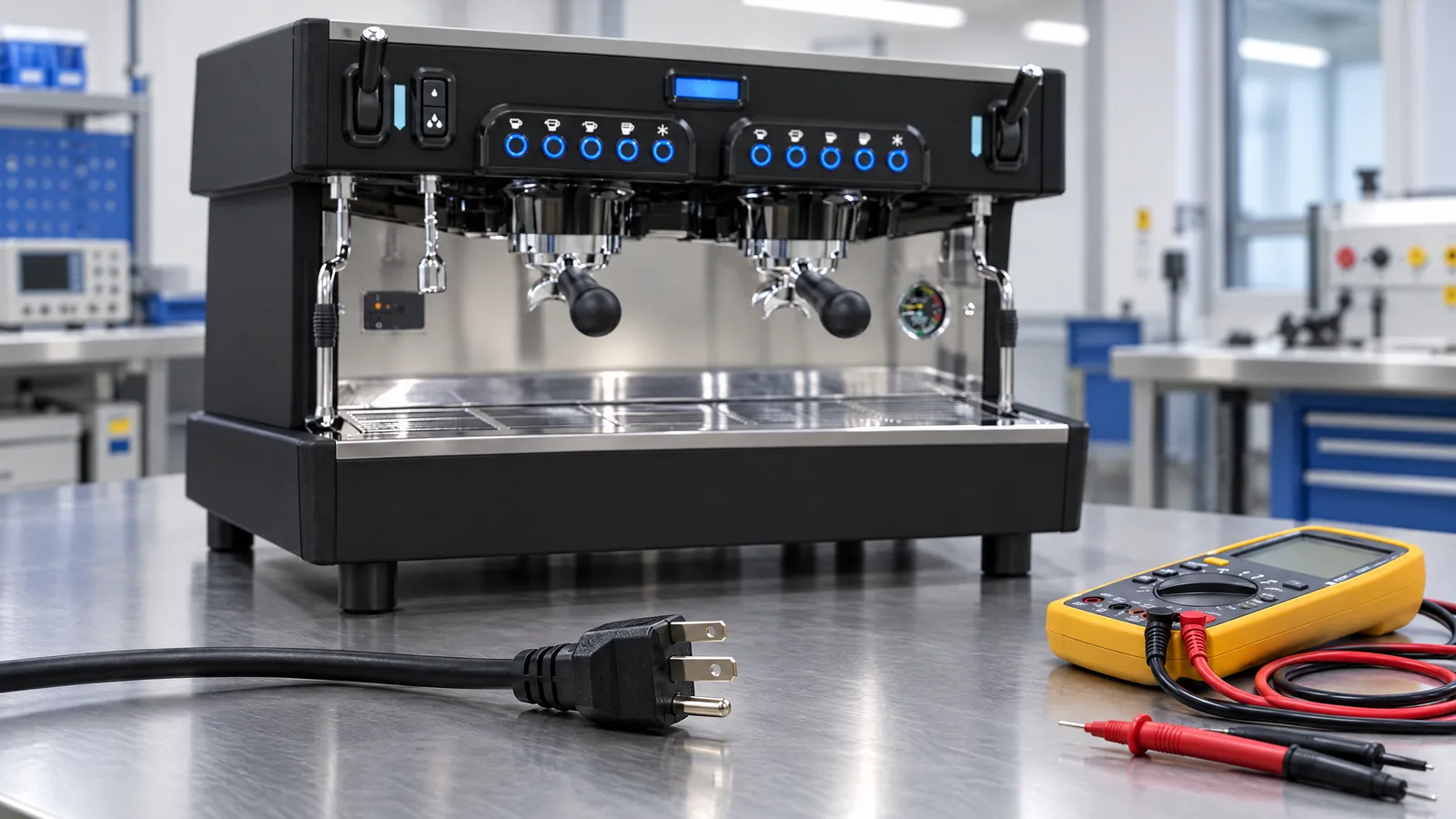
The FCC's Part 15 rules cover radio-frequency emissions from electronic devices. The control electronics inside an appliance are generally exempt from FCC authorisation, provided they cause no harmful interference. A radio is a different matter: a machine with Wi-Fi or Bluetooth contains an intentional radiator, and the radio needs FCC certification.
Using a radio module that already holds its own FCC approval saves most of that work, provided the manufacturer integrates the module the way its approval requires and checks that the finished machine still meets the emission limits.
What does the certification process involve?
The order of work is broadly the same with every laboratory:
- Define the model and the markets: US only, or the US and Canada together, and whether sanitation certification is needed.
- Review the design against the standards before building samples. Most of the cost of certification comes from redesign, and a design review early is the cheapest way to avoid it.
- Choose components that already carry recognition for the North American market.
- Submit samples for testing: temperature rise, dielectric strength, leakage current, abnormal operation and, for sanitation, materials and cleanability.
- Pass the factory inspection. The laboratories inspect the production site before issuing a listing, then return for periodic follow-up inspections, usually unannounced, to check that production still matches the certified design.
- Mark the machine. The listing appears in the laboratory's public directory, and the mark goes on the rating plate.
Certification follows the machine through its life. Changing a component after listing means notifying the laboratory, and sometimes retesting.
Plan the whole process in months, not weeks. The tests themselves take a fraction of that time. The redesign they trigger takes the rest.
Why is not every model sold in North America?
Because each certified version is a separate product to engineer, test, inspect, stock and support. A manufacturer certifies a model for North America when the expected volume pays for:
- the redesign and testing of a separate version;
- the factory inspections that continue for as long as the model is in production;
- a stock of spare parts for that version, which share only some components with the European one;
- trained service partners in the market.
So when a distributor asks for a model that has never been certified there, the answer is usually no, and a certified model from the same range is the realistic alternative. A model that held a listing years ago may not hold one today: a listing stays valid only while the manufacturer keeps the laboratory's follow-up service running.
How can a buyer check a listing?
Ask the supplier for the certification file number, and look it up. UL, Intertek, CSA and NSF each publish searchable online directories of the products they list. The name on the directory entry should match the manufacturer, and the model number should match the machine you are buying.
When is certification not your concern?
If you are buying a machine for your own kitchen at home, these commercial rules do not apply to you in the same way. Household machines follow household standards, and no health inspector visits a private kitchen.
The rules apply in full the moment the machine goes into a business that serves the public. Be wary of two shortcuts:
- "It's CE, so it's fine." CE is a European manufacturer's declaration. US inspectors do not recognise it.
- Converting a European machine after import. Rewiring or changing parts does not create a listing, and it can create a hazard. Laboratories offer field evaluations of individual installed machines, but they are a fallback for one-off cases rather than a way to supply a market.
Frequently asked questions
Is NSF certification required by federal law? No federal law requires it. Local health codes, most of them based on the FDA Food Code, require food equipment that meets accredited sanitation standards, and inspectors use the NSF mark, or an equivalent sanitation mark, as the evidence.
Do UL and ETL test to different standards? No. Both test commercial espresso machines to UL 197. The marks are accepted equally by inspectors.
Does one certification cover the US and Canada? It can. A laboratory can test to UL 197 and CSA C22.2 No. 109 together and issue a single mark with both country indicators.
Our machine has a Wi-Fi module. What extra does it need? FCC certification for the radio. A module that already holds its own FCC approval simplifies this, as long as it is integrated the way its approval requires.
Can a distributor import a European model and certify it locally? Not in any practical way for a product line. Certification covers the design and the factory that builds it, with follow-up inspections, so the manufacturer has to lead it.
This article is part of the Vea Group knowledge base. Vea Group S.p.A. is an Italian designer and manufacturer of professional and premium coffee machines, with heritage dating to 1919 and production in Chignolo d'Isola, Italy, and Suzhou, China.