Short answer: an OEM programme makes sense when you know where you will sell the machine, how many you will sell in the first year, which certifications those markets demand and who will service the machines once they are in the field. If any of those four is missing, start smaller: put your brand on a proven platform, or distribute an existing machine first. OEM is a route to a machine that carries your name. It is a poor route to a cheap machine in a hurry.
Over the past weeks several OEM enquiries have reached us through this site, for very different machines. Each would have been easier to answer with the information in the last section of this article already on the table.
What does "OEM" actually mean for a coffee machine?
OEM, original equipment manufacturing, means a manufacturer engineers and builds a machine that you sell under your own name. In coffee it covers a wide spectrum, and where you sit on it decides almost everything else: cost, volume, risk and time.
Our own OEM work is built on professional equipment: fully automatic and traditional espresso machines, milk systems and the components inside them, for hospitality, offices and foodservice.
We describe it as five levels.
| Level | What is yours | What the manufacturer brings |
|---|---|---|
| Your brand | Logo and start-up screen | A proven platform, already engineered and certified |
| Your colour | Colour parts, finishes, packaging and manuals | The same platform, dressed in your identity |
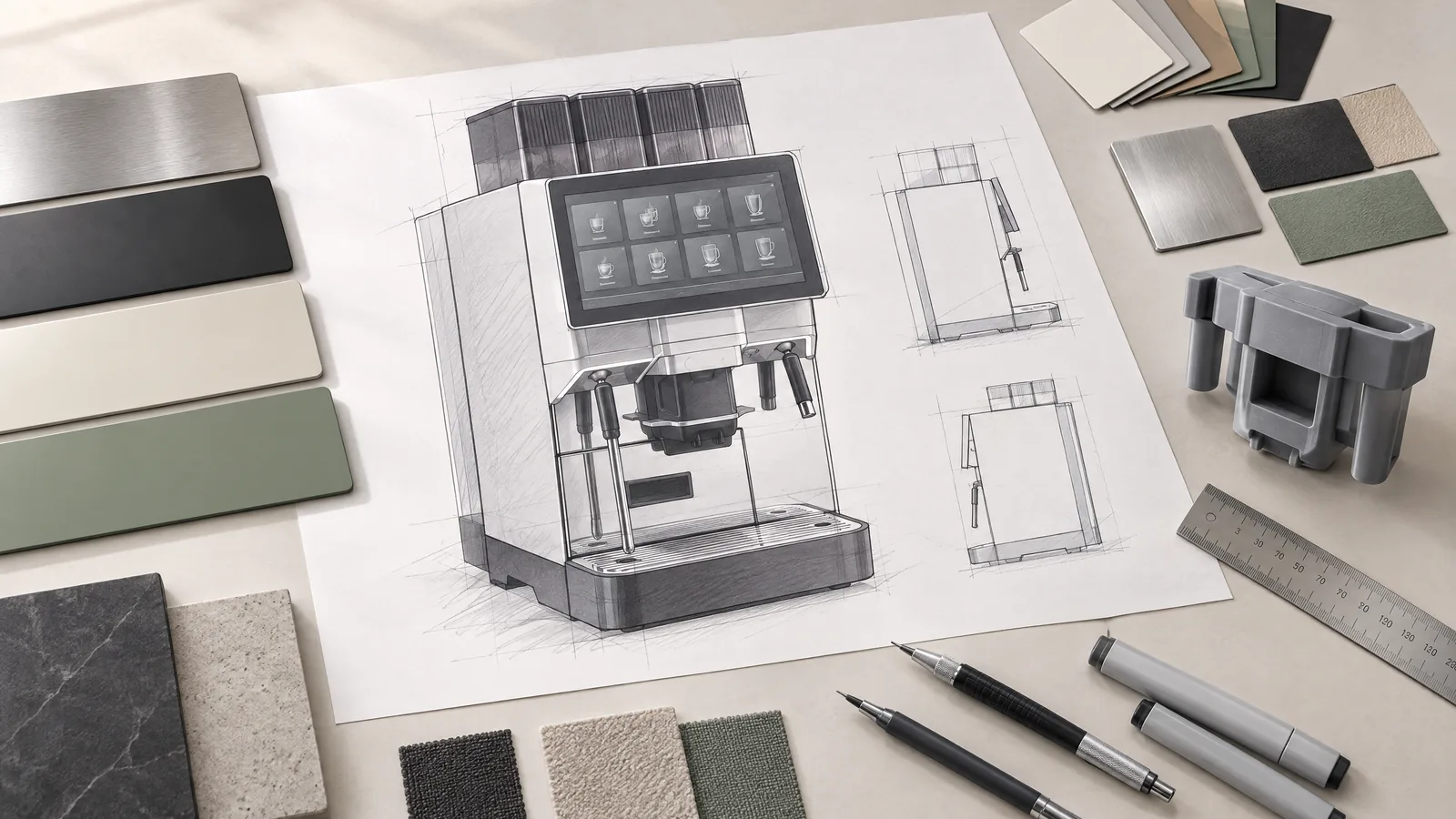
| Your design | The exterior and the user interface | The brewer, grinder and milk system inside |
| Your technology | A subsystem of yours, such as a milk system, software or a payment module | The base machine, integrated and certified with your part as one product |
| Your machine | The whole design | Industrialisation: sourcing, assembly, end-of-line testing, certification and lifecycle support |
Moving down the table, more of the machine belongs to you and more engineering goes into it. The first two levels reuse work the manufacturer has already paid for. The last three create new parts, new tooling and new test campaigns, and each of those needs time and volume to justify it.
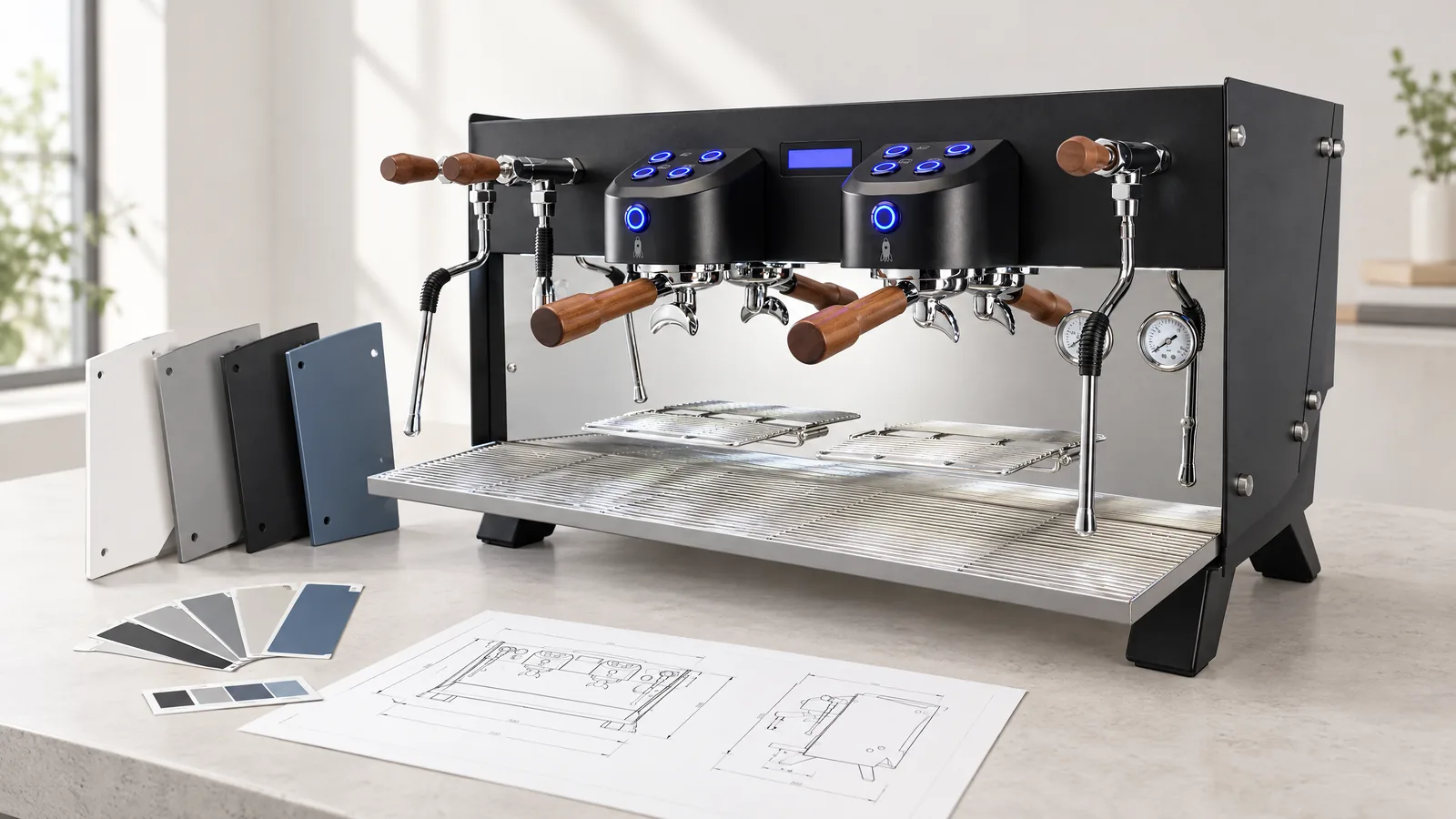
Most brands entering the category are better served by the first three levels than by the last. A distinctive exterior and interface on a proven brewing platform gives customers a machine that looks and feels like yours, with the reliability of an engine that has already run in the field.
Why does a professional platform cost more than a portable or household machine?
If you compare a quote for a professional OEM machine with the shelf price of a household or portable appliance, the gap can look hard to explain. The two products are built to different briefs.
- Duty cycle. A household machine might make a few drinks a day. A professional machine is designed to make hundreds, every day, for years. That changes the brew group, the boiler or heating system, the pump, the valves and the electronics.
- Materials. Every part that touches water, coffee or milk has to meet food-contact rules, and in some markets limits on lead content in wetted parts. Metal brew groups and stainless steel boilers cost more than the plastics a low-cost appliance can use.
- Certification. Professional machines are certified as commercial equipment, market by market. A household appliance follows household standards, and a portable device often a narrower set still.
- Serviceability. A professional machine has to be opened, repaired and returned to service by a technician. That shapes how it is assembled, and it means documentation, exploded views and part numbers for every component.
- Spare parts over years. The manufacturer commits to supplying parts long after the last machine leaves the line. That commitment is part of the price.
If your target retail price is set by the household appliance aisle, a professional platform will not reach it, however the exterior is designed. That is worth knowing before you spend money on industrial design.
How much volume does an OEM programme need?
There is no single minimum, because it depends on the level.
At the first two levels you are buying a configuration of a machine that already exists. Its tooling, its certification files and its spare-parts chain are paid for. Programmes at this level can work at modest volumes, and they are the usual way for a brand to test its market.
At the design level, the new exterior needs its own tooling: moulds, panels, sometimes a new door or cup tray. Someone has to pay for that tooling, either in the unit price over a planned volume or as a separate investment.
At the machine level, the engineering, prototypes, test campaigns and certification all belong to your programme. The volume has to carry them.
Two questions matter more than the headline figure:
- How much of the first-year volume is committed, and how much is forecast? A manufacturer plans components, production slots and stock around orders. A forecast without a first order is a hope, and both sides should treat it that way.
- How steady is the demand? A programme that orders in predictable batches costs less to run than one that arrives in a single burst and then goes quiet.
Where will you sell it, and what does certification involve?
Every target market is a regulatory project. Europe needs CE marking. North America needs electrical safety listing from a recognised laboratory and, for food service, sanitation certification. China needs CCC. Other regions have their own schemes again. We handle compliance for more than 60 markets, and it is the stage that most often decides a launch date.
Two points catch first-time brands out:
- Certification is designed in. The components, the wiring, the materials in contact with water and the markings all have to be chosen with the target standard in mind. Testing a finished design and then fixing it costs more and takes longer.
- A certified machine is certified for its markets, not for the world. A machine built for Europe usually needs a separate version for North America, with different voltage, components and documentation. Our explainer on selling an espresso machine in the US goes through what that involves.
If your plan says "worldwide", narrow it to the first two or three markets. The certification plan for those is the one that sets your schedule.
How long does an OEM programme take?
Longer than most first briefs assume, and the honest answer depends on choices you have not made yet. What sets the timeline:
- The level. A logo on a proven platform and a machine of your own design are different projects, not faster and slower versions of the same one.
- New tooling. Moulds and new panels have their own lead times, and the first parts out of a new tool rarely go straight into production.
- The certification scope. Each additional market adds testing, documentation and sometimes design changes.
- Prototype rounds. Every round of feedback on a prototype adds a loop of changes and checks.
- Your own approvals. Design sign-off, interface text, packaging and manuals all wait for decisions on your side.
A programme moves through the same stages whatever its size: brief and NDA, feasibility and platform choice, concept, design and certification plan, prototype and pre-series, series production, then spares and service. A credible manufacturer gives you a schedule after feasibility, once the platform and the certification scope are fixed. Treat a firm launch date offered before that point with caution.
Who looks after the machine once it is in the field?
Your name is on the machine, so your customers will call you. Before signing, decide:
- Who services the machines in each market: your own technicians, your distributors, or the manufacturer's network.
- Who holds spare parts, how many, and where.
- How technicians get trained and where they find documentation.
- How software updates reach machines already installed, if the machine has software that will change.
The difference between an OEM machine and an OEM programme is everything that happens after the first shipment. A machine in the field without parts and trained people behind it damages the brand on its front panel first.
When is OEM the wrong answer?
Sometimes the best advice we can give is not to start an OEM programme yet.
- You are testing a concept and have no sales channel. Distribute an existing machine first, learn what your customers ask for, then specify your own.
- Your price target comes from the household aisle. A professional platform will not get there.
- You need machines in a few weeks, for a launch event or a trade fair. No serious programme runs on that timescale.
- You cannot fund a stock of spare parts or a service arrangement. The machines will still need both.
- Your volume cannot carry new tooling. Stay at the brand and colour levels until it can.
None of these rules a project out for good. They usually mean starting one level up the table and moving down it as the business grows.
What should you prepare before contacting a manufacturer?
A first conversation goes further when you can answer these:
- Expected volume per year, and how much of it is committed.
- Target markets, in order, and the certifications they require.
- Machine category and drinks menu: fully automatic or traditional, espresso only or milk drinks, hot and cold.
- Design constraints or your design language: what has to look like you, and what can stay as it is.
- Launch window: when you would like machines in the field, and what depends on that date.
Add who will service the machines and how you will sell them, and a manufacturer can come back with a platform proposal and a plan rather than a list of questions. Our newsroom piece From concept to container describes how a programme runs once it starts, and the Industrial & OEM page is where to send a brief.
Frequently asked questions
Can you put our logo on an existing machine? Yes. Your logo and start-up screen on a proven platform is the fastest route to market and carries the lowest risk, because the machine is already engineered, certified and supported.
Will you tell us which brands you build for? No. OEM agreements are confidential, and we describe past projects by type and region rather than by name. Your programme gets the same protection.
Do you sign an NDA before seeing our brief? Yes. The NDA is the first step, before any drawings or volumes change hands.
Can we start small and change the design later? Yes, and it is often the sensible path: launch with your brand and colours on a proven platform, then invest in your own exterior or interface once the volume justifies the tooling.
Can one machine be certified for every market at once? Rarely. Voltage, components, materials and markings differ between regions, so most programmes certify a European version and a North American version separately, then add markets one by one.
This article is part of the Vea Group knowledge base. Vea Group S.p.A. is an Italian designer and manufacturer of professional and premium coffee machines, with heritage dating to 1919 and production in Chignolo d'Isola, Italy, and Suzhou, China.